
Spring Boot + Spring Data MongoDB example
In this article, we will show you how to create a Spring Boot + Spring Data MongoDB application, using Gradle build tool.
- Spring Boot 1.5.1.RELEASE
- MongoDB
- Gradle
- Java 8
1. Project Structure
A standard project structure.
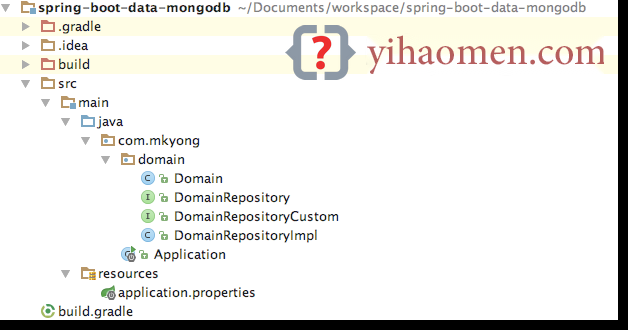
2. Project Dependency
2.1 A Gradle build file.
buildscript {
    repositories {
        mavenCentral()
    dependencies {
        classpath("org.springframework.boot:spring-boot-gradle-plugin:1.5.1.RELEASE")
apply plugin: 'java'
apply plugin: 'eclipse'
apply plugin: 'idea'
apply plugin: 'org.springframework.boot'
jar {
    baseName = 'spring-data-mongodb-example'
    version =  '1.0'
repositories {
    mavenCentral()
sourceCompatibility = 1.8
targetCompatibility = 1.8
dependencies {
    compile 'org.springframework.boot:spring-boot-starter-data-mongodb'
2.2 Declares a spring-boot-starter-data-mongodb, and it grabs a ton of libraries, review the following dependencies :
$ gradle dependencies --configuration runtime
:dependencies
------------------------------------------------------------
Root project
------------------------------------------------------------
runtime - Runtime classpath for source set 'main'.
\--- org.springframework.boot:spring-boot-starter-data-mongodb: -> 1.5.1.RELEASE
     +--- org.springframework.boot:spring-boot-starter:1.5.1.RELEASE
     |    +--- org.springframework.boot:spring-boot:1.5.1.RELEASE
     |    |    +--- org.springframework:spring-core:4.3.6.RELEASE
     |    |    \--- org.springframework:spring-context:4.3.6.RELEASE
     |    |         +--- org.springframework:spring-aop:4.3.6.RELEASE
     |    |         |    +--- org.springframework:spring-beans:4.3.6.RELEASE
     |    |         |    |    \--- org.springframework:spring-core:4.3.6.RELEASE
     |    |         |    \--- org.springframework:spring-core:4.3.6.RELEASE
     |    |         +--- org.springframework:spring-beans:4.3.6.RELEASE (*)
     |    |         +--- org.springframework:spring-core:4.3.6.RELEASE
     |    |         \--- org.springframework:spring-expression:4.3.6.RELEASE
     |    |              \--- org.springframework:spring-core:4.3.6.RELEASE
     |    +--- org.springframework.boot:spring-boot-autoconfigure:1.5.1.RELEASE
     |    |    \--- org.springframework.boot:spring-boot:1.5.1.RELEASE (*)
     |    +--- org.springframework.boot:spring-boot-starter-logging:1.5.1.RELEASE
     |    |    +--- ch.qos.logback:logback-classic:1.1.9
     |    |    |    +--- ch.qos.logback:logback-core:1.1.9
     |    |    |    \--- org.slf4j:slf4j-api:1.7.22
     |    |    +--- org.slf4j:jcl-over-slf4j:1.7.22
     |    |    |    \--- org.slf4j:slf4j-api:1.7.22
     |    |    +--- org.slf4j:jul-to-slf4j:1.7.22
     |    |    |    \--- org.slf4j:slf4j-api:1.7.22
     |    |    \--- org.slf4j:log4j-over-slf4j:1.7.22
     |    |         \--- org.slf4j:slf4j-api:1.7.22
     |    +--- org.springframework:spring-core:4.3.6.RELEASE
     |    \--- org.yaml:snakeyaml:1.17
     +--- org.mongodb:mongodb-driver:3.4.1
     |    +--- org.mongodb:mongodb-driver-core:3.4.1
     |    |    \--- org.mongodb:bson:3.4.1
     |    \--- org.mongodb:bson:3.4.1
     \--- org.springframework.data:spring-data-mongodb:1.10.0.RELEASE
          +--- org.springframework:spring-tx:4.3.6.RELEASE
          |    +--- org.springframework:spring-beans:4.3.6.RELEASE (*)
          |    \--- org.springframework:spring-core:4.3.6.RELEASE
          +--- org.springframework:spring-context:4.3.6.RELEASE (*)
          +--- org.springframework:spring-beans:4.3.6.RELEASE (*)
          +--- org.springframework:spring-core:4.3.6.RELEASE
          +--- org.springframework:spring-expression:4.3.6.RELEASE (*)
          +--- org.springframework.data:spring-data-commons:1.13.0.RELEASE
          |    +--- org.springframework:spring-core:4.3.6.RELEASE
          |    +--- org.springframework:spring-beans:4.3.6.RELEASE (*)
          |    +--- org.slf4j:slf4j-api:1.7.22
          |    \--- org.slf4j:jcl-over-slf4j:1.7.22 (*)
          +--- org.slf4j:slf4j-api:1.7.22
          \--- org.slf4j:jcl-over-slf4j:1.7.22 (*)
3. MongoDB Configuration
#mongodb
spring.data.mongodb.host=localhost
spring.data.mongodb.port=27017
spring.data.mongodb.database=app1
#logging
logging.level.org.springframework.data=debug
logging.level.=error
4. Spring Data – MongoRepository
4.1 A simple model with Spring data annotations.
package com.mkyong.domain;
import org.springframework.data.annotation.Id;
import org.springframework.data.mongodb.core.index.Indexed;
import org.springframework.data.mongodb.core.mapping.Document;
@Document(collection = "domain")
public class Domain {
    @Id
    private long id;
    @Indexed(unique = true)
    private String domain;
    private boolean displayAds;
    //getters and setters
4.2 Extends MongoRepository, you have CRUD function automatically. Spring data come with many magic findBy queries, review the official Spring data MongoDB – Query methods for detail.
package com.mkyong.domain;
import org.springframework.data.mongodb.repository.MongoRepository;
import org.springframework.data.mongodb.repository.Query;
import java.util.List;
// No need implementation, just one interface, and you have CRUD, thanks Spring Data
public interface DomainRepository extends MongoRepository<Domain, Long> {
    Domain findFirstByDomain(String domain);
    Domain findByDomainAndDisplayAds(String domain, boolean displayAds);
    //Supports native JSON query string
    @Query("{domain:'?0'}")
    Domain findCustomByDomain(String domain);
    @Query("{domain: { $regex: ?0 } })")
    List<Domain> findCustomByRegExDomain(String domain);
4.3 To create a custom method for the DomainRepository, you need to create the implementation in another file and make the DomainRepository extends it.
The following example adds a custom ‘update a particular field’ method to MongoRepository
4.3.1 Custom Interface
package com.mkyong.domain;
public interface DomainRepositoryCustom {
    int updateDomain(String domain, boolean displayAds);
4.3.2 The implementation class name is very strict, the name must be "CoreRepositoryInterface" + Impl, read this Spring data MongoDB Custom implementations
package com.mkyong.domain;
import com.mongodb.WriteResult;
import org.springframework.beans.factory.annotation.Autowired;
import org.springframework.data.mongodb.core.MongoTemplate;
import org.springframework.data.mongodb.core.query.Criteria;
import org.springframework.data.mongodb.core.query.Query;
import org.springframework.data.mongodb.core.query.Update;
//Impl postfix of the name on it compared to the core repository interface
public class DomainRepositoryImpl implements DomainRepositoryCustom {
    @Autowired
    MongoTemplate mongoTemplate;
    @Override
    public int updateDomain(String domain, boolean displayAds) {
        Query query = new Query(Criteria.where("domain").is(domain));
        Update update = new Update();
        update.set("displayAds", displayAds);
        WriteResult result = mongoTemplate.updateFirst(query, update, Domain.class);
        if(result!=null)
            return result.getN();
        else
            return 0;
4.3.3 DomainRepository extends the custom interface DomainRepositoryCustom
package com.mkyong.domain;
import org.springframework.data.mongodb.repository.MongoRepository;
import org.springframework.data.mongodb.repository.Query;
import java.util.List;
public interface DomainRepository extends MongoRepository<Domain, Long>, DomainRepositoryCustom {
	//other methods
5. Run
5.1 Spring Boot application.
package com.mkyong;
import com.mkyong.domain.Domain;
import com.mkyong.domain.DomainRepository;
import org.springframework.boot.CommandLineRunner;
import org.springframework.boot.SpringApplication;
import org.springframework.boot.autoconfigure.SpringBootApplication;
import org.springframework.context.annotation.Bean;
@SpringBootApplication
public class Application {
    public static void main(String[] args) {
        SpringApplication.run(Application.class, args);
    @Bean
    CommandLineRunner init(DomainRepository domainRepository) {
        return args -> {
            Domain obj = domainRepository.findOne(7L);
            System.out.println(obj);
            Domain obj2 = domainRepository.findFirstByDomain("mkyong.com");
            System.out.println(obj2);
            int n = domainRepository.updateDomain("mkyong.com", true);
            System.out.println("Number of records updated : " + n);
        };
5.2 Gradle build and run it.
$ gradle build
$ java -jar build/libs/spring-data-mongodb-example-1.0.jar
  .   ____          _            __ _ _
 /\\ / ___'_ __ _ _(_)_ __  __ _ \ \ \ \
( ( )\___ | '_ | '_| | '_ \/ _` | \ \ \ \
 \\/  ___)| |_)| | | | | || (_| |  ) ) ) )
  '  |____| .__|_| |_|_| |_\__, | / / / /
 =========|_|==============|___/=/_/_/_/
 :: Spring Boot ::        (v1.5.1.RELEASE)
//blah blah blah
6. FAQs
6.1 How to create a custom MongoTemple?
A : Declares a new MongoTemplate bean to override the default. In below example, it creates a custom MongoTemplate to remove the _class field.
package com.mkyong;
import org.springframework.boot.SpringApplication;
import org.springframework.boot.autoconfigure.SpringBootApplication;
import org.springframework.context.annotation.Bean;
import org.springframework.data.mongodb.MongoDbFactory;
import org.springframework.data.mongodb.core.MongoTemplate;
import org.springframework.data.mongodb.core.convert.DefaultDbRefResolver;
import org.springframework.data.mongodb.core.convert.DefaultMongoTypeMapper;
import org.springframework.data.mongodb.core.convert.MappingMongoConverter;
import org.springframework.data.mongodb.core.mapping.MongoMappingContext;
@SpringBootApplication
public class Application {
    public static void main(String[] args) {
        SpringApplication.run(Application.class, args);
    //remove _class
    @Bean
    public MongoTemplate mongoTemplate(MongoDbFactory mongoDbFactory,
                                       MongoMappingContext context) {
        MappingMongoConverter converter =
                new MappingMongoConverter(new DefaultDbRefResolver(mongoDbFactory), context);
        converter.setTypeMapper(new DefaultMongoTypeMapper(null));
        MongoTemplate mongoTemplate = new MongoTemplate(mongoDbFactory, converter);
        return mongoTemplate;
References
- Spring Data MongoDB – Reference Documentation
- Working with NoSQL technologies
- Spring Boot Gradle plugin
- Building an Application with Spring Boot
- Gradle – Display project dependency
From:一号门
COMMENTS